
- agroforestry,
- cacao finca costa rica,
- cacao ceremony,
- chocolate master,
- chocolate benefits,
- chocolate bar,
- costa rica exports,
- costa rica forest,
- costa rican chocolate,
- Maleku cacao heritage Costa Rica,
- maleku chocolate,
- maleku costa rica
A Chocolate That Cannot Be Replicated: Why Terroir, Genetics, and Culture Make Maleku Chocolate Irreplaceable
Learn more to understand Maleku Chocolate's terroir coming from the northern side of Costa Rica and the care of the chocolate process
Some things in food can be scaled. A recipe can be standardized. A flavor profile can be approximated. A production process can be exported to a larger facility without fundamentally changing what comes out. The logic of mass production depends on this replaceability: if you can do it once, you can do it a million times.
Maleku Chocolate cannot be done a million times. It cannot be done anywhere else. And that is not a limitation. It is the entire point.
TERROIR: THE VALLEY THAT CANNOT BE MOVED
The Blue Valley Chocolate Farm in Llano Azul sits in the Alajuela highlands of northern Costa Rica, approximately 7 kilometers south of Upala, at the base of Tenorio Volcano. The soil is slightly acidic, naturally low in nitrogen and potassium. Conditions that, under organic management, produce trees that work harder for their minerals, developing more concentrated flavor compounds in each bean. Volcanic geology influences mineral availability in ways that laboratory fertilizer regimes cannot replicate. The proximity to untouched rainforest on the El Higueron Chocolate Farm's 208 acres supports a biological diversity that actively shapes the farm's ecosystem.
This is the terroir that Maleku Chocolate translates into bars. Move the farm and you change the terroir. Change the terroir and you change the chocolate. You cannot move the farm.
GENETICS: 26 VARIETIES GROWN NOWHERE ELSE ON EARTH
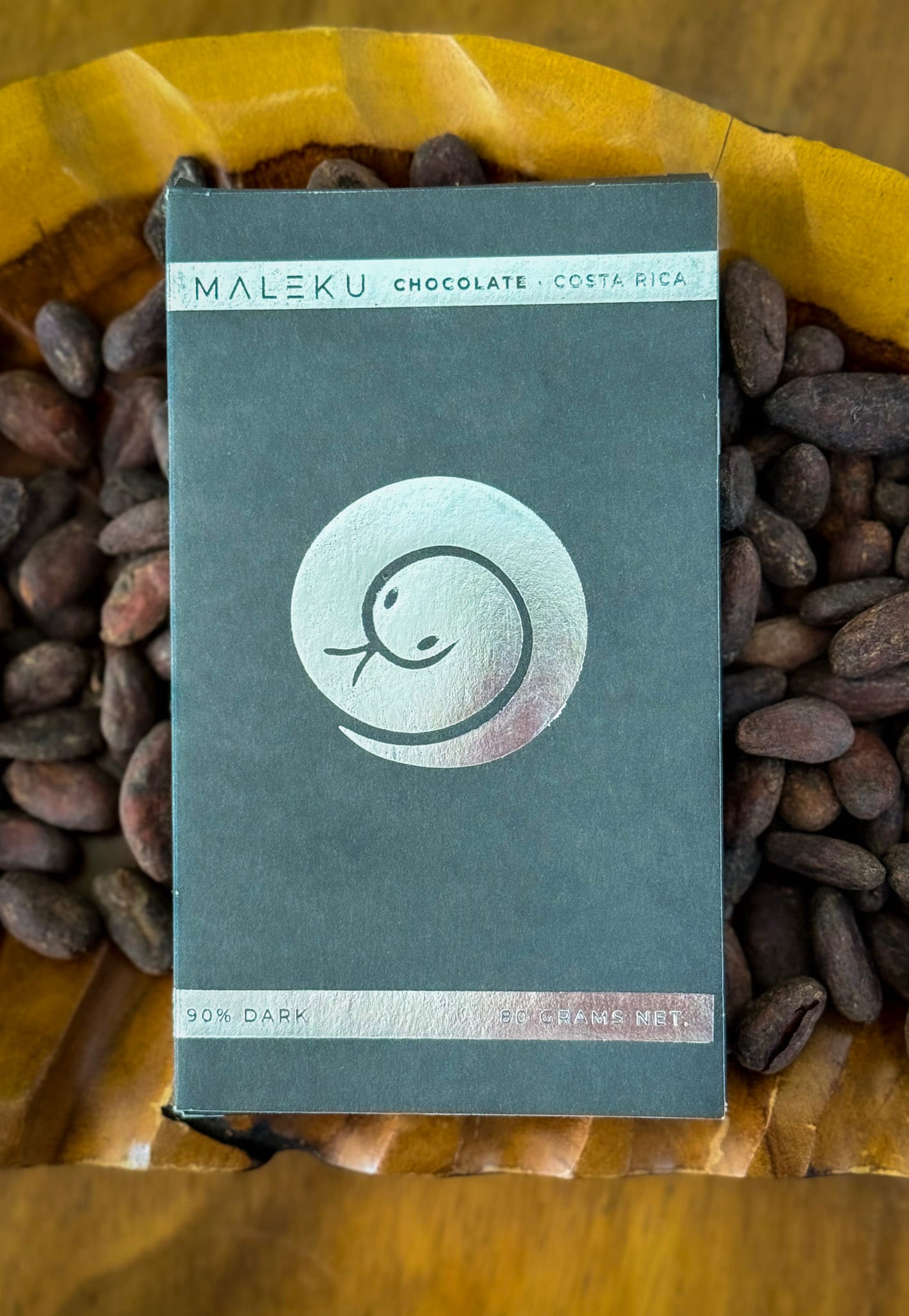
The Blue Valley Chocolate Farm has developed 26 proprietary cacao hybrid varieties, named Maleku 1 through Maleku 26, through years of on-farm selection and grafting. These non-clonal hybrids emerged from the specific growing conditions of the Llano Azul valley and are found nowhere else on earth.
Maleku 2 produces an exceptionally smooth flavor profile at high cacao concentrations - unusually low bitterness and astringency even in an 85% bar. That characteristic is not the result of processing tricks. It is written into the variety's genetic makeup. Costa Rica holds a national classification of 100 percent fine or flavor grade cacao from the International Cocoa Organization - one of fewer than 20 countries in the world with this designation.
Explore the bar collection that these varieties produce.
CULTURE: A RELATIONSHIP 2,300 YEARS IN THE MAKING
In 2019, ceramic fragments discovered during cacao planting on the farm were reported to the National Museum of Costa Rica. The site was registered as a pre-Columbian archaeological monument named Caju (cacao in the Maleku language). Maleku Chocolate is the only chocolate maker in the world to protect a certified pre-Columbian archaeological monument on its working farmland.
A competitor can source fine aroma cacao from Costa Rica. They cannot access this particular valley's 2,300 years of cacao stewardship. They cannot protect the Caju site. They cannot develop 26 varieties from the Llano Azul of Upala soil. The culture is inseparable from the place and the people.
WHY IRREPLACEABILITY MATTERS TO YOU
The nine international awards Maleku Chocolate has received across the International Chocolate Awards and Costa Rica's Feria de Chocolate, including three Gold medals, are the independent verification that this confluence of conditions produces results that stand out even in blind evaluation. Read more about the farm behind every bar at Blue Valley Chocolate, and explore the story and