

- cacao agroforestry carbon and biodiversity,
- cacao from costa rica,
- chocolate bar,
- costa rica forest,
- Maleku single estate cacao difference,
- Maleku single estate cacao experience,
- organic cacao,
- organic chocolate
The Living Forest: Measuring Carbon and Wildlife at Maleku Chocolate Farms
Explore how Maleku Estate measures carbon storage and wildlife presence within its organic cacao forests, proving that fine chocolate, biodiversity, and climate resilience grow together.
A forest that cannot be measured is easy to misunderstand.
At Maleku Chocolate, cacao is grown inside a living forest system rather than alongside one. This means success cannot be defined only by yield, tree survival, or harvest volume. It must be understood through ecological indicators that reveal whether the land is functioning as a system.
Carbon storage and wildlife presence are two of the clearest signals. Together, they tell us whether the forest is recovering, stabilizing, and capable of supporting both biodiversity and fine cacao over the long term.
For Maleku Chocolate, the luxury line from Blue Valley Chocolate, these measurements are not academic. They are directly connected to flavor consistency, agricultural resilience, and long-term integrity.
Why Measuring the Forest Matters
Regenerative agriculture often relies on intention and philosophy. At Maleku Estate, it also relies on observation and verification.
Measuring carbon and wildlife allows us to evaluate whether our agroforestry systems are actually restoring ecological function or simply reducing harm. It replaces assumption with evidence and helps guide decisions year after year.
A living forest responds to how it is managed. Measurement allows us to listen.
Carbon Storage as a Sign of Stability
Carbon storage at Maleku Estate is not treated as a separate climate project. It is a consequence of how the land is structured.
Multi-layered cacao agroforestry systems store carbon in several interconnected reservoirs:
- Permanent shade trees that accumulate long-term biomass
- Diverse root systems that store carbon below ground
- Soil organic matter built through constant leaf litter and decomposition
- Reduced disturbance that protects existing carbon stocks
By tracking tree growth, canopy density, and soil organic matter, we can see whether the system is gaining or losing carbon over time. Increases indicate stability and regeneration. Losses signal stress.
Carbon does not lie. It reflects how the system is functioning.
Soil Carbon and the Invisible Foundation
Soil holds more carbon than trees, and it changes more slowly.
At Maleku Chocolate farms, soil is treated as a living layer rather than a substrate. Organic matter is continuously added through shade tree litter, cacao pruning, and natural decay. Synthetic inputs are avoided to protect microbial life.
As soil carbon increases, water retention improves, erosion decreases, and nutrient cycling stabilizes. These changes directly affect cacao health and fermentation quality.
From a chocolate maker’s perspective, soil carbon translates into consistency rather than surprise.
Wildlife as a Biological Indicator
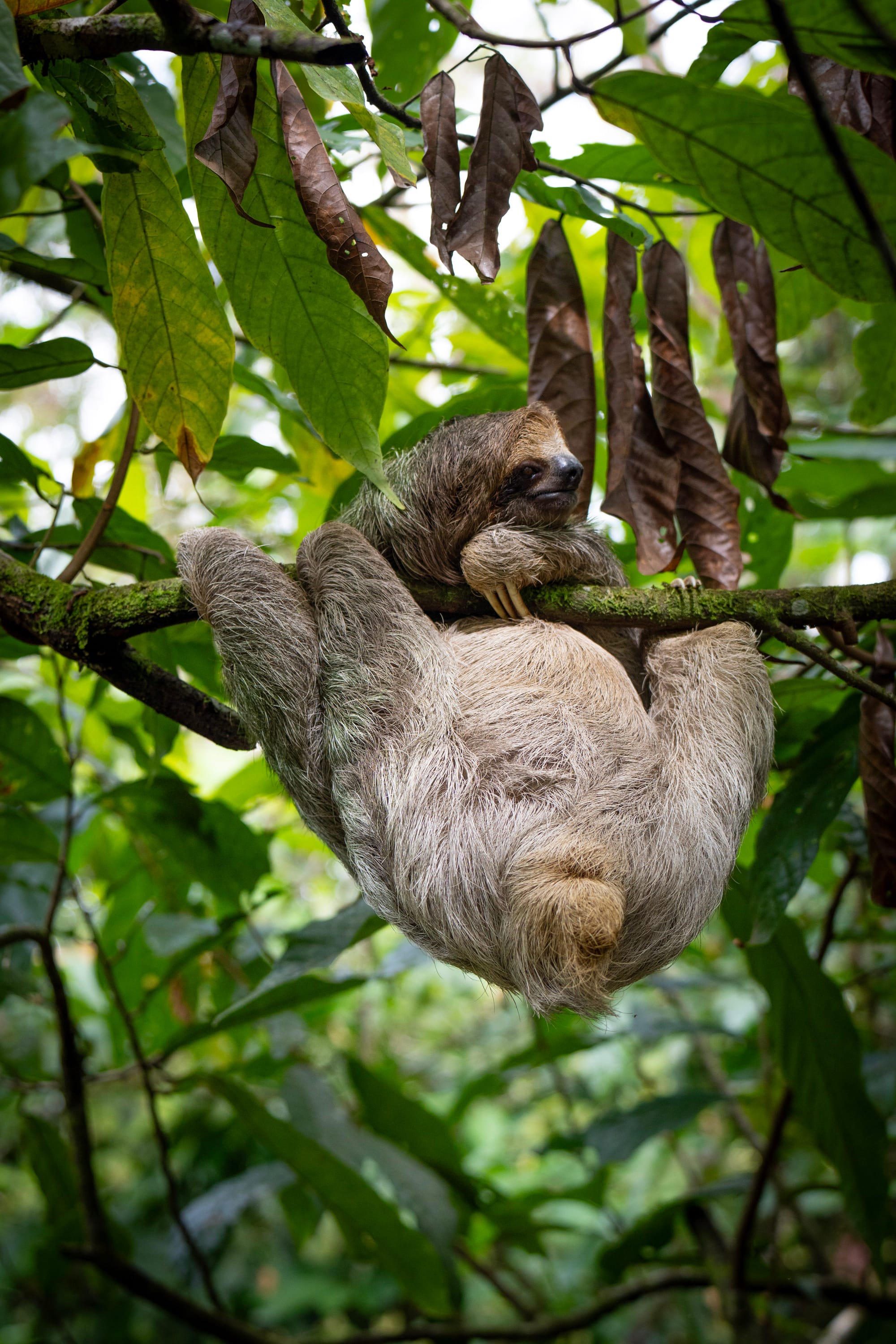
Wildlife does not return to landscapes that are unstable or toxic. Its presence is one of the most reliable indicators of ecological health.
At Blue Valley Chocolate - Llano Azul farm, birds, insects, amphibians, and small mammals are observed as part of understanding how the forest functions. Their return signals that habitat quality is improving and that food webs are reconnecting.
We pay attention to:
- Bird diversity that supports natural pest control
- Pollinating insects that improve flowering and fruit set
- Amphibians that indicate clean water and stable humidity
- Predator species that regulate ecological balance
These species respond to real conditions, not intentions.
Forest Structure Creates Habitat
Biodiversity depends as much on structure as it does on species.
At Blue Valley Chocolate - Llano Azul, canopy layers are intentionally maintained. Tall shade trees create temperature stability. Mid-level fruit and timber species add habitat diversity. Cacao occupies the understory. Ground cover protects soil and supports insects.
This vertical complexity allows multiple species to coexist without competition and reduces vulnerability to climate extremes.
When storms arrive or rainfall shifts, the forest absorbs impact rather than collapsing.
Linking Ecology to Cacao Quality
The connection between a living forest and cacao quality is direct.
Cacao grown in stable forest systems experiences less stress. Flowering cycles become more consistent. Pod development slows naturally, allowing sugars to accumulate evenly.
This results in:
- Cleaner acidity
- More uniform fermentation
- Better internal bean structure
- Clearer fine aroma expression
Flavor becomes a reflection of balance rather than compensation.
Monitoring as an Ongoing Practice
Measurement at Blue Valley Chocolate - Llano Azul is not a one-time assessment.
Carbon levels, tree growth, and wildlife presence are observed across seasons and compared over time. These patterns inform decisions about planting density, shade management, and species selection.
This feedback loop allows the forest to evolve intelligently rather than through trial and error.
A living system requires continuous attention.
Why This Matters for Luxury Chocolate
Luxury chocolate depends on reliability without uniformity. It requires systems that improve over time rather than degrade.
Maleku Chocolate relies on cacao grown in landscapes that are stable across decades, not just productive in favorable years. Carbon storage and biodiversity are not secondary benefits. They are what make single-estate cacao viable long term.
Without a living forest, fine aroma cacao becomes unpredictable.
Costa Rica as a Natural Context
Costa Rica’s biodiversity provides the raw potential for regenerative cacao systems. At Blue Valley Chocolate - El Higueron, that potential is guided through measurement rather than assumption.
The result is a farm that functions as both production system and ecological corridor, supporting wildlife while producing cacao of exceptional clarity.
This is conservation practiced through agriculture.
From Data to Meaning
Carbon measurements and wildlife observations are not goals by themselves. They are signals.
They tell us whether the land is healing. They reveal whether decisions are aligned. They show whether the future of the estate is secure.
Chocolate becomes the expression of that security.
A Forest That Responds
The most important measurement at Maleku Estate is response.
When birds return. When soil deepens. When cacao stabilizes.
These responses confirm that the forest is alive.
Chocolate Rooted in Living Systems
At Maleku Chocolate, we do not separate flavor from forest.
The living forest is not background scenery. It is infrastructure. It stores carbon, supports wildlife, and creates the conditions for cacao to express itself honestly.
When you taste Maleku Chocolate, you are tasting a forest that is measured, understood, and allowed to function.
This is not conservation observed from a distance. This is conservation grown, measured, and sustained.
