

- agroforestry,
- cacao bioactive compounds,
- what does cacao do to your brain,
- theobromine benefits,
- theobromine chocolate,
- dark chocolate science
What Cacao Actually Does to Your Brain and Body: The Science Behind Every Bite (Single-Estate, Costa Rica)
Theobromine, anandamide, flavanols, PEA, magnesium. Cacao contains compounds that scientists have spent decades studying. Here is what the research actually shows, and why it matters for what you eat.
There is a moment after eating a square of good dark chocolate where something shifts. The body settles. Focus sharpens slightly. There is a warmth that has nothing to do with temperature. People have noticed this for thousands of years, and for most of that time it was described in spiritual or cultural terms: cacao as a gift from the gods, as medicine, as ceremony.
Modern science is arriving at something more specific. Inside the cacao bean, researchers have identified a collection of bioactive compounds, each with its own mechanism, each affecting the body in measurable ways. What was once explained through myth now has a molecular explanation.
What follows is an honest accounting of those compounds: what the peer-reviewed research actually shows, and why the decisions made on a single farm in Costa Rica determine how much of that science survives into your bar.

THE COMPOUND THAT GIVES CACAO ITS CHARACTER: THEOBROMINE
Before getting into mechanisms and clinical trials, it is worth saying plainly: not all cacao is equal. The compounds described in this article are present in the raw cacao bean. How many survive fermentation, roasting, and processing depends entirely on how the cacao was grown and handled. We will return to this point throughout, because it is the difference between eating something with a documented effect and eating something that merely shares a name with it.
With that foundation in place: if you had to name the compound that makes cacao uniquely cacao, it would be theobromine. Theobroma, the genus name of the cacao tree, literally means "food of the gods" in Greek. Theobromine is named after the plant, not the other way around.
Structurally, theobromine is a methylxanthine, the same class of molecule as caffeine. The difference is meaningful. Caffeine has three methyl groups attached to its xanthine core. Theobromine has two. That structural difference makes theobromine significantly milder in its stimulant effects, with a longer half-life in the body, and without caffeine's sharper spike-and-crash pattern.
How it works in the body:
Theobromine operates through two primary mechanisms. First, it inhibits phosphodiesterase enzymes (PDEs), which leads to increased levels of cyclic adenosine monophosphate (cAMP) inside cells. Elevated cAMP signals smooth muscle to relax, which produces vasodilation: widening of the blood vessels. Second, theobromine partially blocks adenosine receptors. Adenosine is the molecule that accumulates in your brain during waking hours and progressively makes you feel tired. By occupying some of those receptor sites, theobromine reduces adenosine's sleep-promoting signal, producing a gentle, sustained alertness without the nervous edge that heavier adenosine-blocking compounds like caffeine can create.
What the research shows:
The vasodilating effect of theobromine has attracted serious cardiovascular research interest. A 2022 randomized controlled trial published in the American Journal of Clinical Nutrition - the COSMOS (COcoa Supplement and Multivitamin Outcomes Study) trial, led by researchers at Brigham and Women's Hospital - followed 21,442 adults over nearly four years and found that daily cocoa flavanol supplementation was associated with a statistically significant reduction in cardiovascular mortality (Sesso et al., 2022, doi.org/10.1093/ajcn/nqac055).
A 70% dark chocolate bar contains approximately 250 to 300 mg of theobromine per 40g serving. Milk chocolate contains less, because a lower proportion of the bar is actual cacao. White chocolate, which is made from cacao butter without the solids, contains almost none.
THE BLISS MOLECULE: ANANDAMIDE AND THE ENDOCANNABINOID SYSTEM
In 1992, Czech chemist Lumir Ondrej Hanus and American pharmacologist William Devane, working at the Hebrew University of Jerusalem, isolated a previously unknown compound in the human brain that bound to the same receptors as THC, the active molecule in cannabis. They named it anandamide, from the Sanskrit word ananda, meaning bliss.
Two years later, a landmark study published in Nature found anandamide in cacao (di Tomaso, Beltramo, Piomelli, Nature 1996, doi.org/10.1038/382677a0).
Anandamide is an endocannabinoid: a cannabinoid your body produces naturally. Its primary target is the CB1 receptor, concentrated in the brain and central nervous system. When anandamide binds to CB1 receptors, it modulates the release of other neurotransmitters, influencing mood, memory, appetite regulation, and pain perception. It is one of the compounds responsible for what runners describe as a runner's high, and it plays a role in the generally pleasant sensation of being alive and well.
The nuance worth understanding:
Cacao contains anandamide itself, but in relatively small quantities. More significantly, cacao contains compounds that inhibit the enzyme (fatty acid amide hydrolase, or FAAH) responsible for breaking down anandamide in the body. Two of these inhibitor compounds, N-linoleoylethanolamide (LEA) and N-oleoylethanolamide (OEA), are present in meaningful concentrations in raw and minimally processed cacao. Their effect is to extend the time anandamide remains active in the body, rather than directly flooding the system with it. The result is a gentler, more sustained shift in mood rather than an acute high.
This is a distinction that matters for how you read claims about cacao and the endocannabinoid system. Cacao does not produce a cannabis-like effect. What it does is support the natural function of a system your brain already uses to regulate wellbeing.
Why processing matters:
The anandamide content of finished chocolate depends heavily on how the cacao was handled. Heat during roasting degrades some of these compounds. Alkalization (the Dutch-processing technique used in many commercial cocoa powders) strips polyphenols aggressively. Research has documented that fermentation alone reduces total cacao polyphenols by approximately 70% through enzyme-driven oxidation, and roasting can reduce flavanol content by a further 27 to 90% depending on temperature and duration (Hurst et al., Journal of Agricultural and Food Chemistry, 2008).
This is one of the core arguments for minimal-process, bean-to-bar chocolate from known farms. When you can trace the cacao back to the tree, know how it was fermented, and know it was not alkalized, you are buying a product where more of the original compound profile survived the journey.

FLAVANOLS: THE COMPOUNDS WITH THE STRONGEST CLINICAL EVIDENCE
If theobromine is cacao's most distinctive compound and anandamide is its most poetic one, the flavanols are the compounds with the most robust clinical research behind them.
Flavanols are a subclass of flavonoids, which are a large family of plant polyphenols. The primary flavanols in cacao are epicatechin, catechin, and their oligomeric forms called procyanidins. Cacao is one of the richest dietary sources of epicatechin on earth. A single 40g serving of high-quality dark chocolate can deliver more epicatechin than a cup of green tea.
The cardiovascular picture:
Flavanols improve endothelial function, which is the health and responsiveness of the cells lining your blood vessels. The mechanism involves stimulating the production of nitric oxide (NO), a molecule that signals blood vessel walls to relax and dilate. Better endothelial function is associated with lower blood pressure, reduced arterial stiffness, and improved blood flow to organs including the brain and heart.
The COSMOS trial tested 500 mg of cocoa flavanols per day (including 80 mg of epicatechin) in a randomized, double-blind, placebo-controlled design over 3.6 years. The results: a 27% reduction in cardiovascular mortality versus placebo across more than 21,000 participants (Sesso et al., 2022, doi.org/10.1093/ajcn/nqac055). A 27% reduction in cardiovascular mortality in a properly controlled trial of that scale is not a footnote.
The cognitive picture:
The COSMOS-Mind substudy, published in Alzheimer's and Dementia, tested the same intervention in 2,262 participants focused specifically on cognitive outcomes. It found a statistically significant improvement in global cognition over 3.6 years, with the strongest effects in participants who had poor diet quality at baseline (Baker et al., 2023, doi.org/10.1002/alz.12767). Regular flavanol intake, in other words, appeared to help protect and improve cognitive function, particularly for people whose diets were already falling short.
Researchers attribute this to two mechanisms: the flavanols' nitric oxide pathway improving cerebral blood flow, and their antioxidant activity reducing oxidative stress in neural tissue (Socci et al., Frontiers in Nutrition, 2017, doi.org/10.3389/fnut.2017.00019).
PHENYLETHYLAMINE: THE TRACE COMPOUND WITH A BIG REPUTATION
Phenylethylamine (PEA) is a trace amine that your brain produces naturally in small quantities. It acts on a class of receptors called trace amine-associated receptors (TAARs), particularly TAAR1, triggering the release of dopamine and serotonin. Elevated PEA levels are associated with heightened alertness, focused attention, and improved mood. Low PEA levels have been linked to depressive states.
Cacao contains PEA in measurable quantities. The challenge is delivery: PEA is rapidly metabolized by monoamine oxidase B (MAO-B) in the gut wall and liver before much of it reaches the brain. This limits how much consumed PEA actually crosses the blood-brain barrier.
However, cacao also contains compounds that mildly inhibit MAO-B activity, and the overall matrix of stimulant and mood-modulating compounds in cacao may create a synergistic environment in which PEA's effects are amplified relative to what you would see from PEA in isolation.
The honest scientific position on PEA in cacao is this: the compound is real, its neurochemical mechanisms are well-established, but the degree to which dietary PEA from chocolate produces measurable mood effects in humans is still an area of active research. What is clear is that PEA is one thread in a more complex neurochemical conversation that cacao initiates, rather than a standalone actor.
MAGNESIUM: THE QUIET ESSENTIAL
Cacao is one of the most magnesium-dense foods available. A 40g serving of 70% dark chocolate contains approximately 50 to 70 mg of magnesium, or roughly 15% of the recommended daily intake for an adult.
Magnesium is involved in over 300 enzymatic reactions in the human body. For the purposes of brain and mood function, the most relevant roles are: regulation of NMDA receptors (which control neuronal activity and learning), production of serotonin and dopamine, and regulation of the HPA axis, which governs the stress response. Chronic magnesium deficiency is associated with increased anxiety, disrupted sleep, and higher risk of depression.
The magnesium in cacao exists in a highly bioavailable form. Some research suggests that the flavonoids present in cacao may further enhance magnesium absorption, meaning the compound arrives in a matrix that also aids its uptake.
This is not a trivial point. Many people in Western diets are chronically low in magnesium. Cacao is not a supplement, but it is a genuinely meaningful dietary source of a mineral that affects how the brain functions at a basic level.
WHY A SINGLE ESTATE IN COSTA RICA MATTERS TO THE COMPOUND PROFILE
All of the above compounds are present in cacao. The question of how much survives into your finished bar depends on decisions made long before the chocolate reaches the store.
Farming and soil: The concentration of polyphenols in cacao is influenced by growing conditions. Cacao grown under agroforestry canopy, in mineral-rich volcanic soil, with genuine biodiversity in the root ecosystem, produces a different phytochemical profile than cacao grown in stripped monoculture conditions. The plant's polyphenol production is partly a stress response: an adaptive mechanism the tree uses to protect itself from UV radiation and pathogen pressure. Shade-grown cacao under a living forest canopy develops differently from sun-exposed industrial cacao. Neither the science nor the farming is fully separable.
Fermentation: Fermentation is necessary for flavor development, but it does reduce polyphenol content. The goal in quality chocolate production is to achieve the flavor transformation that fermentation produces while limiting the polyphenol loss. This requires controlled fermentation conditions, correct timing, and careful monitoring, not industrial speed.
Roasting: Lower-temperature roasting preserves more of the native flavanol profile. This is why the roasting approach in a bean-to-bar operation is a genuine product decision, not an aesthetic one. Higher temperatures produce faster roasts and slightly different flavor profiles, but they cost compounds.
Alkalization: Dutch processing (treating cacao with an alkalizing agent to reduce acidity and darken color) dramatically reduces polyphenol content. This is why the research on flavanols consistently uses non-alkalized cacao as its test material, and why alkalization is identified in the literature as one of the most significant sources of compound loss in commercial chocolate production.
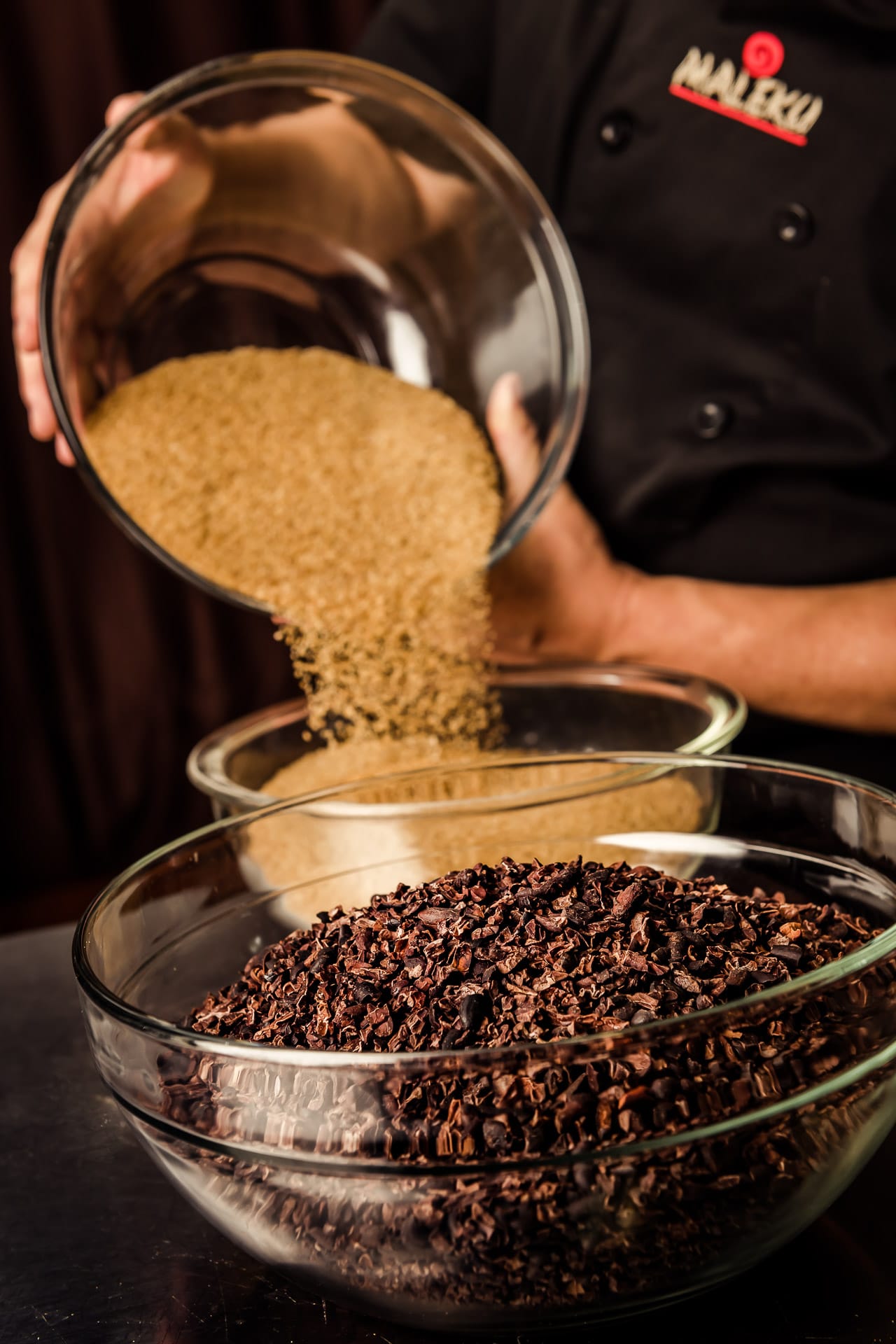
At Maleku Chocolate, the cacao is grown at a single estate in Llano Azul, Costa Rica, in organic volcanic soil at the base of Tenorio Volcano, fermented on-site using traditional wooden box methods, and processed without alkalization or additives. The bars are certified organic under USDA NOP standards (Kiwa BCS Costa Rica Limitada). These are not marketing claims. They are the conditions under which more of the compound profile described in this article survives into the finished bar.
WHAT THIS MEANS WHEN YOU CHOOSE A BAR
The science of cacao's bioactive compounds does not mean that every chocolate bar is a wellness product. The clinical trials behind cacao's most studied compounds are among the largest and most rigorous in nutritional science. But the concentration and integrity of those compounds in any finished chocolate depends entirely on what happened between the tree and the wrapper.
A bar made from alkalized cocoa powder, blended with artificial vanilla and a long list of emulsifiers, shares a category name with a single-estate, non-alkalized, minimally processed bar, but not much else. The compounds that drive the research are not the same compounds that survive industrial processing at scale.
This is the reason origin matters. Not as a romantic idea, but as a chemistry decision.
When you choose a 70% bar made from traceable, organically grown, non-alkalized cacao, you are choosing a product where the theobromine, the flavanols, the anandamide precursors, the magnesium, and the full compound matrix described above are present in meaningful, research-consistent concentrations. The pleasure of eating good chocolate and the science of what it does to your body are, in this case, the same story.
If you want to experience what that looks like in practice, Maleku Chocolate's 70% dark bar is the place to start. It is grown at a single estate in Costa Rica, fermented on-site, roasted at low temperature, and never alkalized. Every compound described in this article had the best possible conditions to survive into what you are holding.
That is not a marketing claim. It is the outcome of a set of deliberate decisions, made on a specific piece of land, by people who understand what those decisions cost and why they matter.
Explore the Maleku Chocolate bar range and read more about how the farm shapes what ends up in the bar in our piece on The Science Behind Organic Cacao
REFERENCES
All citations are linked inline throughout the article. Full reference list:
1. Sesso et al. COSMOS trial. American Journal of Clinical Nutrition, 2022. https://doi.org/10.1093/ajcn/nqac055
2. Baker et al. COSMOS-Mind substudy. Alzheimer's and Dementia, 2023. https://doi.org/10.1002/alz.12767
3. di Tomaso, Beltramo, Piomelli. Brain cannabinoids in chocolate. Nature, 1996. https://doi.org/10.1038/382677a0
4. Hurst et al. Polyphenol processing losses in cocoa. Journal of Agricultural and Food Chemistry, 2008.
5. Ramos, S. Dietary polyphenols and signalling pathways. Molecular Nutrition and Food Research, 2008.
6. Socci et al. Enhancing Human Cognition with Cocoa Flavonoids. Frontiers in Nutrition, 2017. https://doi.org/10.3389/fnut.2017.00019
7. Latif, R. Chocolate/cocoa and human health. Netherlands Journal of Medicine, 2013.