
- agroforestry,
- artisanal chocolate,
- cacao from costa rica,
- cacao finca costa rica,
- chocolate benefits,
- costa rican chocolate,
- maleku costa rica
The Silence of the Forest
Explore the inside of a mature cacao agroforestry system that you will not find in a conventional plantation.
There is a particular quality of quiet that exists inside a mature cacao agroforestry system that you will not find in a conventional plantation. It is not the absence of sound. Birds are active in the canopy. Insects move through the leaf litter. Occasionally a pod drops. But the underlying ambient register is different from the noise of exposed, wind-battered open fields. The shade canopy absorbs and diffuses. The layered vegetation softens the air. And if you stand still long enough, you begin to understand that what feels like silence is actually the sound of a system that is working without stress.
That quality of working without stress is not incidental to the chocolate Maleku Chocolate produces. It is one of its primary causes.
WHAT THE FOREST DOES THAT A FIELD CANNOT
Cacao trees are not field plants. In their origin range in the upper Amazon basin, they evolved as subcanopy species: mid-story trees adapted to filtered light, consistent humidity, and the biological complexity of a forest floor. Their root systems were designed to interact with mycorrhizal fungi. Their leaf surfaces were never meant to absorb full tropical sun for eight to ten hours a day. Their pod development was calibrated to the moderate, stable temperatures of a sheltered understory.
When cacao is grown in full-sun monoculture, it produces more pods per tree in the short term because photosynthesis runs at full capacity. But the tree is also under chronic stress. Temperature swings between day and night are more extreme. Soil moisture evaporates faster. The microbial communities that drive nutrient cycling are reduced by the absence of leaf litter diversity and by the compaction that follows when ground cover is removed. Yield goes up for a few years, and then the soil biology degrades and the trees weaken.
The agroforestry system at the Blue Valley Chocolate Farm in Llano Azul and the El Higueron Chocolate Farm runs on an entirely different logic. Across approximately 241 acres and more than 67,000 cacao trees, the farms are designed as layered systems: shade trees above, cacao in the middle, ground cover and decomposing leaf matter below. The shade canopy moderates temperature, maintains soil humidity during dry season, and continuously returns organic matter to the forest floor. The cacao tree is never asked to operate outside the conditions it evolved to handle.

THE SOUND OF GOOD FERMENTATION STARTS IN THE GROUND
Flavor in fine chocolate is often traced to fermentation and roasting, and those stages matter enormously. But the chemical precursors that fermentation and roasting work with - the amino acids, the reducing sugars, the specific fatty acid profile of the cacao butter - are determined by the tree's biology, and the tree's biology is shaped by its growing environment. A tree grown in depleted soil with a simplified microbial community produces a bean with a narrower precursor profile. A tree growing in biologically rich, aerated, mycorrhizal-connected soil has access to a broader mineral and nutrient spectrum. That spectrum shows up in the flavor complexity of the finished bar.
This is the link between the silence of the forest and the character of the chocolate you taste. The undisturbed soil biology of a mature organic agroforestry system is not just a sustainability credential. It is a flavor input. Maleku Chocolate manages both its farms without synthetic fertilizers or pesticides, maintaining the soil biology that makes this input possible season after season.
HOW A TREE COMMUNICATES STRESS
Experienced cacao farmers read their trees the way a physician reads a patient. Leaf color tells you something about mineral availability. The texture of new growth tips indicates whether the tree is drawing enough water from the soil. The density of flower cushion development on the trunk and major branches - cacao flowers cauliflorous, directly on the wood rather than at branch tips - indicates the tree's readiness to invest in reproduction.
A stressed tree does not flower well. A tree that is chronically short of phosphorus, zinc, or magnesium will produce fewer and smaller pods. A tree that has spent the dry season fighting temperature stress will show it in the thinness of the pod wall and the reduced sugar content of the pulp - which means the fermentation will have less to work with and the resulting chocolate will have less flavor depth.
The quiet, sheltered conditions of a well-managed agroforestry farm are the conditions under which cacao trees express their full biological potential. The forest is not silent because nothing is happening. It is quiet because everything is happening correctly, at the right scale and pace.
26 VARIETIES, EACH WITH ITS OWN VOICE
The Blue Valley Chocolate Farm has developed 26 proprietary cacao hybrid varieties, named Maleku 1 through Maleku 26, found nowhere else on earth. These are not uniform, industrially selected clones optimized for yield and shipping durability. They are farm-specific selections, each with distinct characteristics that emerged from the particular soil, microclimate, and biological community of the Llano Azul valley at the base of Tenorio Volcano.
Maleku 2, for instance, produces an unusually smooth flavor profile at high cacao percentages. Its astringency is low and its bitterness restrained, even in an 85% bar, in a way that traces directly to the variety's specific tannin and flavonoid profile. That characteristic is genetic and environmental together. The variety emerged from conditions on this farm, adapted to its particular expression of the forest's chemistry. Learn more about the farms behind every bar at Blue Valley Chocolate.

TASTING WHAT THE FOREST BUILT
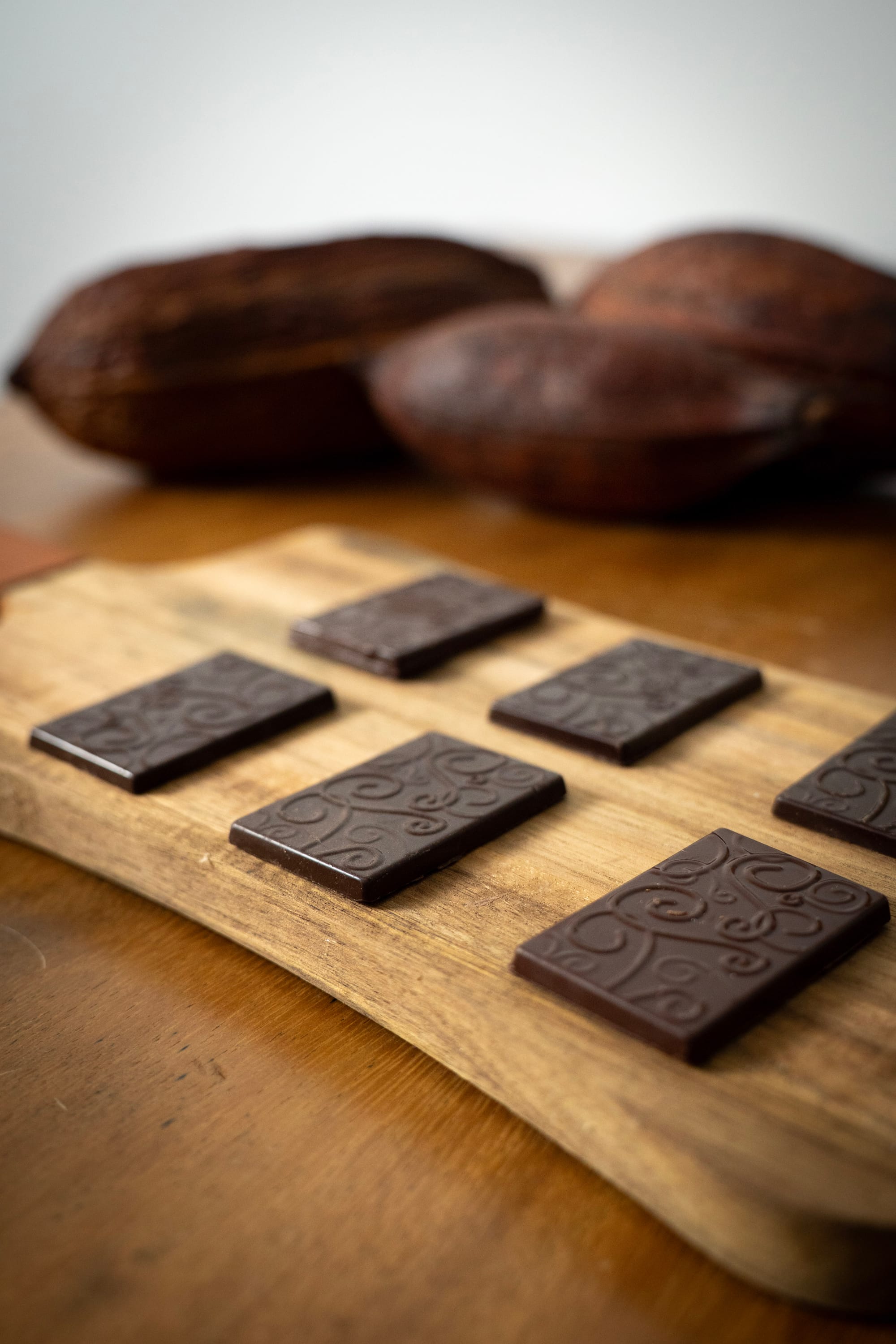
When you open a bar of Maleku Chocolate and register the progression from the first contact on the palate through the mid-development to the finish, you are tasting the cumulative output of the forest system. The fruity, clean top note is the ester profile formed during fermentation from pulp sugars that developed in shade-grown, unhurried pods. The body - the depth that comes in as the chocolate melts fully - carries the mineral complexity of soil that has been managed organically and biologically for years. The finish, its length and cleanliness, reflects the quality of the bean's precursor chemistry and the precision of the roast applied to it.
None of that is manufactured in the factory. The factory's job is to not lose what the forest already built.
Maleku Chocolate's nine international awards across the International Chocolate Awards and Costa Rica's Feria de Chocolate, including three Gold medals, are the external record of what this system produces at its best. Taste the result in the full bar collection, or explore the sustainability approach that makes the system possible.