

- Maleku indigenous Costa Rica,
- Maleku cacao heritage Costa Rica,
- maleku chocolate,
- maleku costa rica,
- Maleku indigenous cacao heritage Costa Rica,
- cacao bean to bar
The Maleku: What You Need to Know About Costa Rica's Smallest Indigenous Group
There are approximately 650 Maleku people remaining on earth.
I want to start with that number because it is the number that changes how you read everything that follows. Not six hundred and fifty thousand. Not six thousand. Six hundred and fifty people - distributed across three small communities in a reservation in northern Costa Rica, holding a language spoken by fewer than 300 of them, maintaining a culture that has survived rubber slavery, land dispossession, and centuries of colonial pressure.
The Maleku are not widely written about in English. Academic literature on them is sparse compared to better-documented groups like the Bribri or the Maya. What exists tends to frame them through the lens of what has been lost. This article tries to do something different: document who the Maleku are, what they have built, and why - for a brand that carries their name on every bar of chocolate it sells - understanding them accurately and specifically is not optional.
Location and Territory: The Gap Between What Was and What Is
The Maleku live in the Guatuso Indigenous Reserve in Alajuela Province, in northern Costa Rica near the town of San Rafael de Guatuso. The reserve sits in a lowland valley between the Tenorio Volcano range and the Nicaraguan border - a landscape of rivers, wetlands, and tropical forest, roughly an hour north of La Fortuna.
The three communities within the reserve are Palenque Tonjibe (the largest, known in Maleku as Tojifa Cha carraco), Palenque Margarita (Ijico), and Palenque El Sol (Caronhco). They sit along the Toji river - the Río Sol - in a stretch of roughly six kilometers of gravel road between the towns of Guatuso and La Fortuna. The reserve formally allocated to them totals approximately 3,000 hectares. Of that, only about 15% is actually in Maleku hands. The remaining 85% is occupied by non-Maleku settlers, in what amounts to one of the most sustained and least-remedied cases of indigenous land dispossession in Costa Rica.
The numbers produced by Costa Rican academic research on this point are striking. Field research by geographer Roberto Castillo Vásquez, published in the Universidad de Costa Rica's Revista Reflexiones, reconstructed the Maleku's historical territory using native toponyms gathered in collaborative fieldwork. His findings: at the midpoint of the nineteenth century, the Maleku occupied an area of approximately 100,000 hectares - centered on the basin of the Río Frío and its tributaries, extending to the border with Nicaragua. That territory supported between 17 and 23 distinct Maleku settlements. Today, the community holds around 600 hectares in the reserve - approximately 0.6% of their historical land.
The contrast is visible from the road. The land the Maleku occupy is forested and reforested - jungle, growing things, intentional planting. The land occupied by non-Maleku settlers is open cattle pasture. That difference is not coincidence. It is two fundamentally different relationships with land, made visible.
Within that ancestral territory lies a wetland region the Maleku know as Toro Lhami - what is now the Caño Negro wildlife refuge, still accessed traditionally by boat along the Ucurinh (the Río Frío). This area contains fishing, hunting, and resting sites alongside locations with direct significance to Maleku ontology - sacred sites and forbidden sites, categories maintained in oral tradition and now being documented by linguists conducting fieldwork in the communities. Access to some of these places by boat has been restricted in recent decades - another quiet erosion of the relationship between the people and their ancestral land.
Costa Rica's 1977 Indigenous Law (N°6172) and the UN Declaration on the Rights of Indigenous Peoples both state that indigenous territories are exclusive to indigenous peoples and cannot be expropriated. But the government's failure to enforce these protections has produced the situation on the ground: legal rights and practical dispossession, a gap that remains unresolved. In 2012, a group of Maleku community members occupied an estate established illegally within their reserve boundary - asserting in action the rights they hold on paper.
A History That Did Not Follow the Expected Script
Most indigenous peoples in the Americas trace their greatest disruption to Spanish colonization in the sixteenth and seventeenth centuries. The Maleku story is different in a way that matters.
The Maleku were largely unknown to the Spanish until the mid-eighteenth century, and even then they successfully resisted conquest. The people who nearly destroyed them were not Spanish colonists but Nicaraguan rubber barons in the nineteenth century - powerful private interests who entered Maleku territory to harvest rubber and took what they needed, including people. Maleku men were captured, enslaved, and trafficked for labor. The community's population collapsed.
The people who finally helped stop the rubber barons were Catholic missionaries - who gave the Maleku metal tools, woven clothing, and guns in exchange for access to their community. The Maleku accepted the help and the missionaries helped drive off the rubber barons. But the missionaries also introduced Christianity, and with it began the gradual erosion of the Maleku's own religious and cosmological traditions. Toca, their creator god, is still known by name - but few Maleku worship Toca today except in ceremonial re-enactments staged for cultural tourism.
This layered history - pre-Columbian independence, rubber slavery, missionary influence, land dispossession, and legal but unenforced rights - is the actual context in which the Maleku's current situation must be understood. It is a story of extraordinary resilience against specific, identifiable forces of destruction. It is not a vague narrative of "cultural decline."
The Language: Maleku Jaica and What Its Survival Requires
The Maleku language is called Maleku Jaica (also written Maléku Jaíka, also historically known as Guatuso). It belongs to the Chibchan language family - specifically the Votic branch. Linguist Adolfo Constenla Umaña of the Universidad de Costa Rica, who produced the authoritative Gramática de la Lengua Guatusa (EUNA, 1998), identifies Maleku Jaica as one of only two extant languages in the Votic branch of Chibchan - the other being Rama, spoken in Nicaragua, which is even more endangered. Both languages sit at the edge of a language family that has been eroding for centuries.
The Costa Rica national census of 2011 (INEC) recorded approximately 330 Maleku language speakers - all bilingual in Spanish, with no monolinguals remaining. By 2022, field linguist Roberto Herrera Miranda, working across all three communities for the Endangered Languages Documentation Programme, estimated the number of speakers at approximately 300. The direction of travel is clear.
What makes this particularly urgent is a pattern documented consistently by researchers: children in the communities speak Spanish with each other almost exclusively. Adults use Maleku Jaica more with family and close acquaintances. The social language - the language of peer interaction and daily life - has already shifted. Reversing that shift once it is established is extraordinarily difficult, and the Maleku community and the researchers working with them know it. Research published in the Universidad Nacional's Revista Electrónica Educare specifically examines the challenge of building school-based language strategies capable of closing this gap - integrating Maleku customs, oral tradition, and language into the curriculum before it becomes unreachable.
The Maleku have chosen deliberate resistance. Maleku Jaica is taught formally in community schools. Radio Maleku broadcasts in the language from Tonjibe, the largest community. Language learning posters produced through the Endangered Languages Documentation Programme have been distributed in local schools. A lexical database of Maleku Jaica is being compiled from recorded field sessions - over 100 hours of video and audio, transcribed and translated - that document everything from botanical knowledge to traditional narratives to accounts of seasonal travel across the ancestral territory.
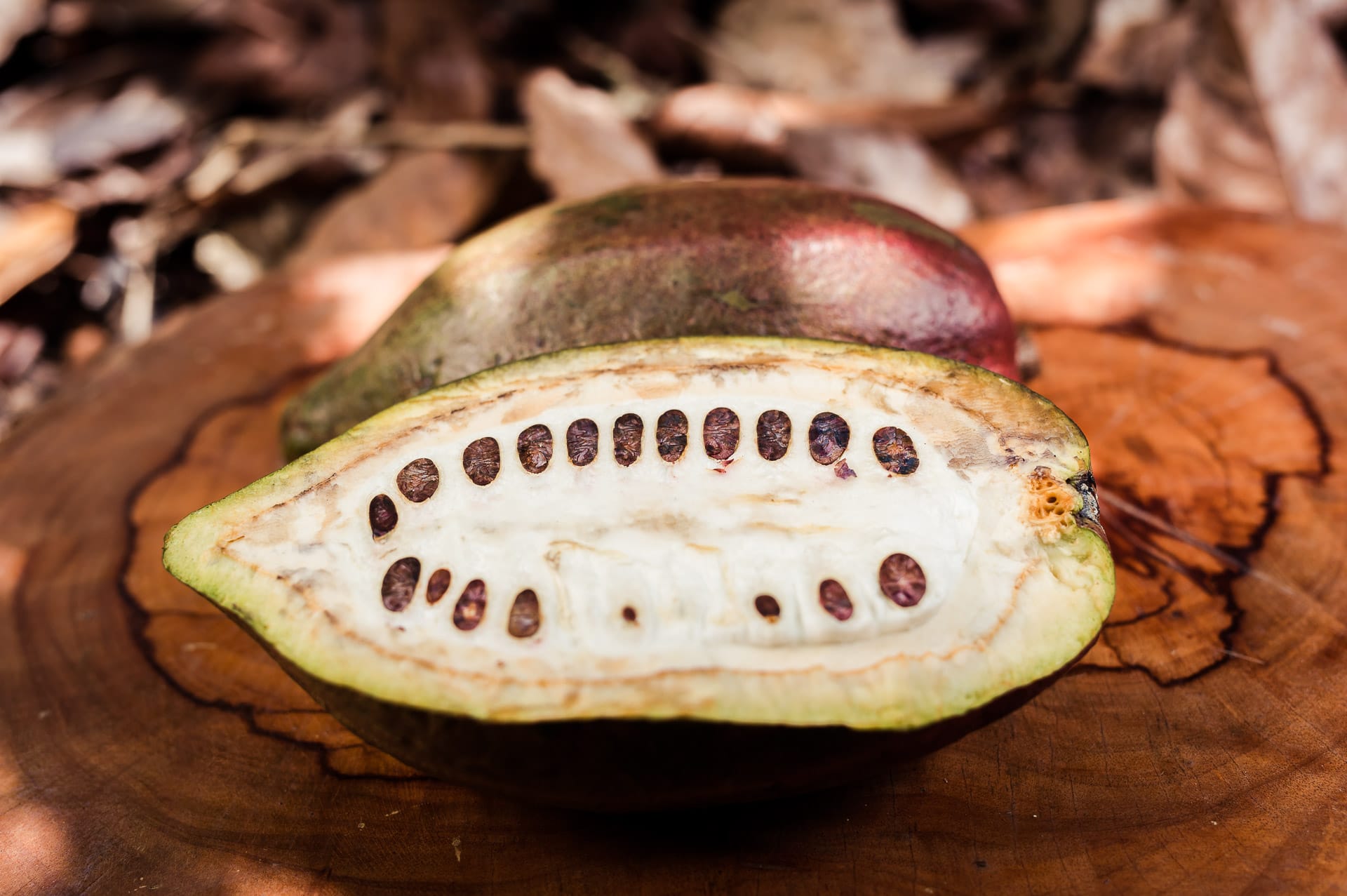
One detail from that archive is worth pausing on. The Maleku word for cacao is "caju." The pre-Columbian archaeological site on the Blue Valley Chocolate farm at El Higuerón, registered with the National Museum of Costa Rica (site A-549 Ca), bears that name: Caju. The word was already there, in the land, before the chocolate company existed. It is the same word.
The stakes of language loss extend beyond culture into practical survival. The Maleku's ecological and medicinal knowledge - accumulated over millennia of managing a specific rainforest ecosystem, knowing which plants treat which conditions, how to read the forest, how to navigate the rivers - exists primarily encoded in Maleku Jaica. When children at the community learn medicinal plant identification, it is in part because the nearest hospital is hours away and that knowledge is not metaphorical: it can save lives.
The language and the knowledge it carries are not separate things.
Reforestation: Not a Project. A Purpose.
The Maleku's most visible and stated primary mission is reforestation. This is not a conservation program attached to a grant. It is described by community members themselves as the central expression of who they are and what they owe the land.
The small portion of reserve land the Maleku control has been comprehensively reforested. What was degraded and cleared when they received the reserve has been planted back. They are now working outward - preparing seedlings and trees for distribution to landowners across the wider Guatuso area, working to reforest land beyond their own boundary even when that land is not yet legally theirs.
The program includes species selected for specific ecological functions: trees that stabilize riverbanks, species that attract wildlife, plants that are themselves near extinction and need placement in the right habitat. The Maleku run what amounts to a community nursery - germinating, growing, and distributing plants based on accumulated knowledge of what each species does and where it belongs.
Community leader Alcides Elizondo Castro, speaking to Cultural Survival, put it directly: "Indigenous land means oxygen." The Maleku goal is not to preserve their territory as a museum. It is to return it to functional forest - with jaguars, falcons, the specific birds and animals that their cosmology considers kin. The goal is a living ecosystem, not a managed reserve. And it is also a spiritual goal: according to Maleku tradition, the gods granted their people a territory rich with rivers and lagoons as the foundation of their existence. Recovering that territory, and the water sources within it, has both practical and sacred dimensions.
On the reserve, the difference between Maleku land and non-Maleku land is already visible. The Maleku land is jungle. The cattle land is not. This is not metaphor. It is what you see from the road.
Art, Craft, and the Economics of Cultural Survival
The Maleku are renowned for their artisanal work - particularly hand-painted balsa wood masks and jicara gourd bowls. These objects are both cultural expressions and economic lifelines, sold to tourists visiting the reserve and to retailers and cultural organizations across Costa Rica and internationally.
The tradition of mask-making and gourd-painting encodes visual cultural knowledge - animals, spiritual relationships, cosmological narratives specific to Maleku tradition. Each object that leaves the reserve carries something of that tradition outward, into contexts where it might prompt a question about who made it and why.
Maleku Chocolate purchases these objects directly from the community. Not as a sourcing arrangement, but as a direct economic relationship between people who use the brand name and the people whose name it is. The purchases go directly to the artisans. There are no intermediaries.
What 650 People Can Still Do
Six hundred and fifty people is a population small enough to feel fragile. It is also a population small enough that individual choices carry disproportionate weight - in both directions.
The Maleku have already reforested their own land. They are reseeding and distributing trees for an area far larger than their reserve. They have kept a language alive that was moving toward extinction. They have maintained cultural traditions - art, medicine, spiritual practice - through centuries of disruption that would have ended other communities entirely.
None of this happened because conditions were favorable. The conditions have consistently been hostile: land dispossession that is still legally unresolved, economic marginalization, a language under pressure from a dominant culture, a population too small to be politically significant in the way larger groups can be.
What the Maleku demonstrate is that the size of a community is not the limit of its impact. Alcides Elizondo Castro said it in terms of oxygen. Jakhima, the shaman and leader of Palenque Margarita who gave Maleku Chocolate permission to carry this name, said it in terms of story: he wanted more people to know the Maleku existed. Every bar of Maleku Chocolate sold anywhere in the world carries that request forward.
That is a small thing by most measures. It is also the thing Jakhima asked for.
---
By Gideon Rubin
Owner, Maleku Chocolate / Blue Valley Chocolate
Maleku Chocolate is made in Costa Rica, named with the permission and purpose of Jakhima and the Maleku community of the Guatuso Reserve. Every bar carries their name so that more people will ask what it means. Learn more at www.malekuchocolate.com.