

- artisanal chocolate,
- chocolate awards,
- chocolate master,
- maleku chocolate,
- maleku costa rica,
- Maleku indigenous cacao heritage Costa Rica,
- master chocolatier,
- Maleku single estate cacao flavor development
The DNA of Flavor: Inside the Maleku Single-Estate Lab
Go inside the Maleku single-estate cacao lab where flavor is shaped through fermentation analysis, roasting precision, and fine aroma cacao development rooted in Costa Rica.
Flavor is the result of structure, timing, and attention. When chocolate tastes precise, balanced, and expressive, it is because every variable has been questioned and understood.
At Blue Valley Chocolate, the single-estate lab is where that work happens. Not a laboratory in the sterile sense, but a working space where cacao is studied, challenged, and refined with discipline.
This is where flavor is built, not imagined.
Why We Treat Flavor Like Genetics
Every cacao bean carries information. Genetics determine its potential and fermentation is the step that unlocks it. Roasting shapes it. Refining and conching either preserve it or erase it.
When we talk about the DNA of flavor, we mean that each sensory note can be traced back to a decision. Nothing appears by chance or by accident.
In the lab, we break cacao down to understand it. Not to manipulate it, but to listen to what it is telling us.
This approach allows us to repeat excellence and avoid mistakes.
Single-Estate Focus Changes Everything
When one works with single-estate cacao it means consistency without anonymity. Each lot behaves differently, even within the same farm. Rain patterns, harvest timing, biodiversity and microclimate leave their mark.
Every estate is treated as its own system, and we could even say that every farm is also treated as its own. We document behavior across harvests. We taste it repeatedly and compare data against sensory outcomes.
This work builds a memory for the cacao. Over time, the estate reveals its strengths and its limits. That knowledge becomes flavor discipline.
Fermentation Analysis as the First Layer
Fermentation is where most flavor is either created or destroyed. In the lab, we analyze fermentation results before chocolate is ever made.
We assess acidity, aromatic development, bitterness structure, and balance. We evaluate cut tests and aroma release. We track temperature curves and duration.
The goal is not intensity but alignment.
Fine aroma cacao requires restraint. Over-fermentation leads to noise. Under-fermentation leaves the cacao mute. So we need to make sure to understand this balance.
The lab exists to find that narrow, correct window.
Roasting as Precision, Not Fire
Roasting is often misunderstood as a flavor generator. In reality, roasting is a translator that reveals what fermentation has already written.
In our Blue Valley Chocolate factory, roast profiles are developed through repetition and tasting, not formulas. Time, temperature, airflow, and batch size are adjusted carefully.
We roast to protect structure. Acidity must remain clean. Aromatics must stay intact. Bitterness must be controlled rather than erased.
When roasting is done correctly, nothing dominates. The cacao remains legible.
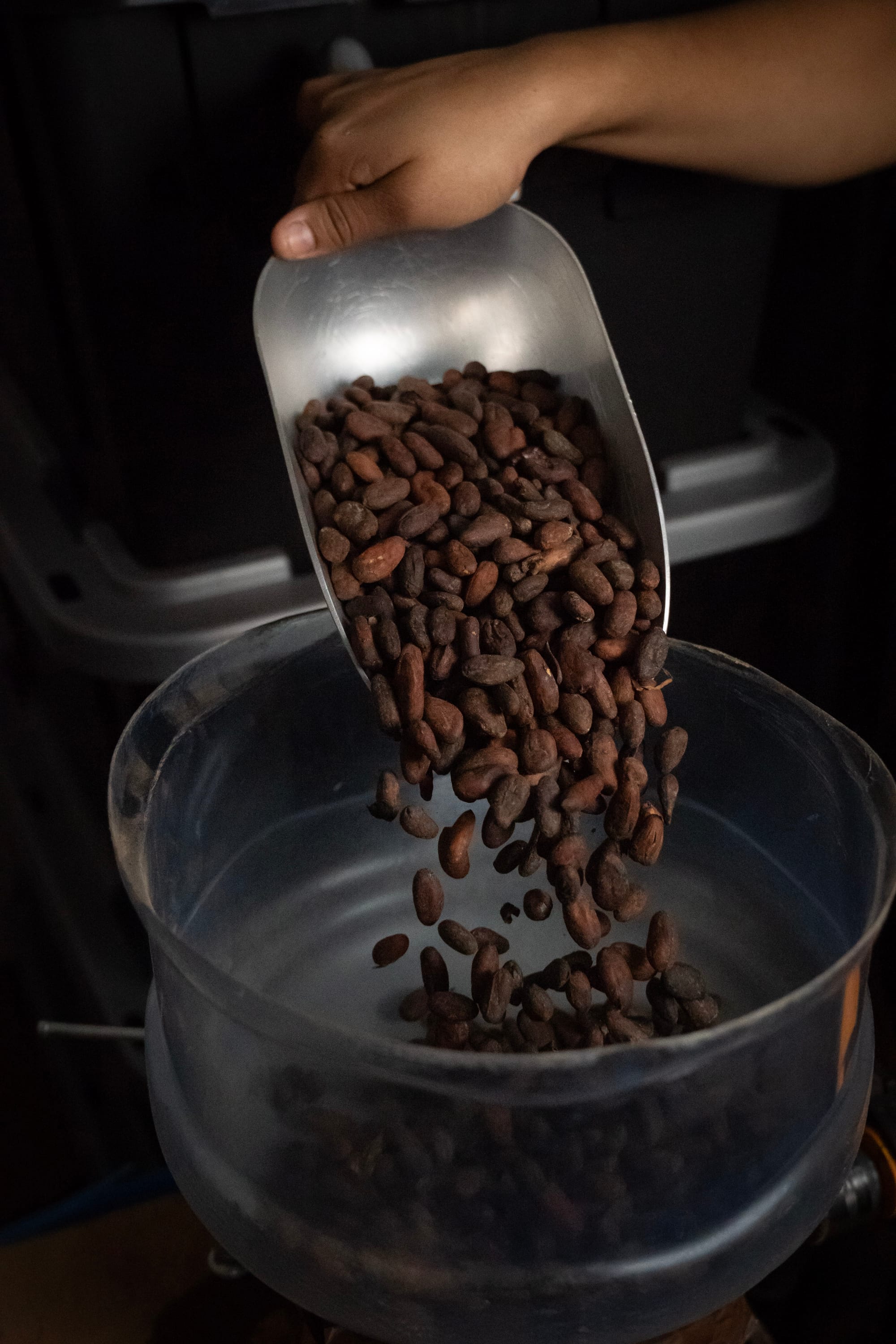
Grinding, Refining, and Texture Control
Flavor does not live only in aroma. Texture changes perception. Particle size is adjusted with intent. Too coarse and the chocolate feels aggressive. Too fine and it becomes flat.
Refining time is tracked carefully. Conching is not extended to chase smoothness at the expense of flavor. Every adjustment has a consequence.
This is where many chocolates lose their identity. We guard against that.
Sensory Evaluation Is the Final Authority
Data matters. Technique matters. But flavor is decided by the palate.
Every lab decision ends in tasting. Slowly. Repeatedly. Without distraction.
We evaluate attack, mid-palate, finish, and aftertaste. We look for clarity rather than volume. We look for memory rather than shock.
When a chocolate finishes clean and invites another bite, the work has succeeded.
Why This Matters to the Final Bar
The lab exists so that the final bar feels effortless. No harsh edges. No muddled notes. No corrections disguised as flavor.
When chocolate is made this way, it does not need explanation. It communicates directly.
This is what single-estate chocolate should do.
Discipline Over Drama
There is no romance in the lab. Only repetition, patience, and honesty.
We reject shortcuts because cacao exposes them. Every decision is recorded in the final taste.
That discipline is what allows Maleku chocolate to remain consistent while still expressing the natural variation of each harvest.
The Role of a Chocolate Maker
A chocolate maker is not an inventor. We like to see a chocolate maker as a translator. And the lab is where that translation becomes precise.
We do not impose flavor. We uncover it.
Flavor That Can Be Traced
When someone tastes a Maleku Chocolate bar and recognizes balance, clarity, and length, they are tasting hundreds of quiet decisions made in the lab.
Single-estate cacao allows those decisions to matter.
That is the DNA of flavor. Contact us to learn more: https://www.malekuchocolate.com/#contact

